Costly Screw-ups at the ‘Top’ Hurt UK

Great promises and poor results
Many years ago, my (tiny) company won a key public sector contract. There I was, a new seven-figure deal in hand, entering a world I didn’t know. Before long, I learned that public projects and effectiveness seldom go hand in hand. Sadly, the pristine three-factor promise morphed into reasons for screw-ups. The promises and good intentions at the top were enmeshed in an unreliable tangle of ideology, power and multiple agendas. The three groups of people became ineffective.
- Making Policy involved very powerful people, politicians, mandarins, advisers; accepted thinking, ideology, concepts, dogma; entrusted responsibility, clean hands, expedience and buck-passing. The coalface experience and hard-won expertise seemed limited at best.
- Implementing Policy relied on somewhat powerful people, seniorish politicians, officials and consultants; their working style, embattled-busy, pressurised, sounding good; delegated responsibility, shouting orders, bossing the troops, demanding results.
- Policy implementation low-to-no power people, middle-order & downwards, all roles; follow orders, blameable, powerless, compliant; capability and capacity – often overlooked, knowledgeable, experienced, cynical, pressurised yet often still committed. Coalface experience could be present yet seldom consulted.
As a result of personal contact and meetings, I encountered a dysfunctional world of screw-ups waiting to happen. The irony of all this clutter suggests that the massive potential of most of the people involved lay untapped. Talk about frustrating.
Are silly, damaging, screw-ups at the top inevitable?
How often do we hear weasel-worded excuses for failure from faux-contrite ministers? Politicians who, at the outset, exuded confidence backed by trenchant promises.
At the simplest level, certain elements prove tricky because of factors like:
- insufficient comprehension of reality
- incomplete planning
- feeble budgetary control
- a top-down communication style (institutional deafness)
- limited follow-up
- dissembling, fudging and invisibility when things go wrong (as they will)
Without a doubt, a lack of diagnosis, management and project planning at the highest levels dooms or damages government projects long before their implementation.
Why do we routinely accept bravura avoidance of accountability for endemic failure, cost overruns, and delays? Would things be different if leaders spent their own money?
Sometimes I wonder whether the world is being run by smart people who are putting us on or by imbeciles who really mean it. Laurence J. Peter, The Peter Principle
 Promises, Promises
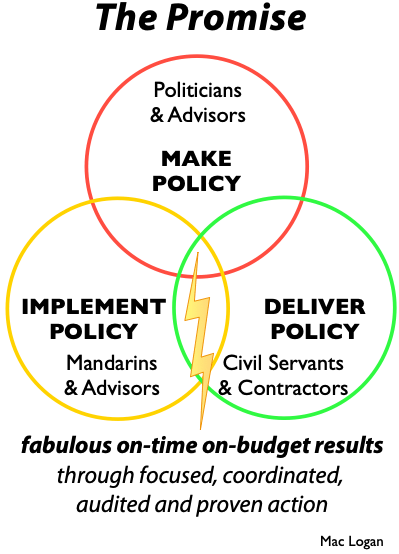
Hope springs eternal, but effectiveness requires competence and pragmatism. In the beginning, we are promised superb outcomes… everything will be achieved on time, within budget, and with absolutely no possibility of failure. How well does your experience match the optimism?
When you get right down to it, enabling excellent outcomes depends on three overlapping worlds cooperating, communicating and engaging expertly seamlessly. Achieving such success involves three factors, as mentioned above:
- Make Policy
- Implement Action
- Deliver Results
While citizens’ experience may cast doubt on our politicians’ delivery effectiveness and highlight their hubris. Imagine the electorate’s delight if political promises at the outset matched perfect outcomes on completion.
That seldom happens. Why do we re-elect incompetents, time after time? Should we (can we?) insist on a change in how our electoral system operates – its norms, weaknesses and cupidity?
It can’t be denied that in the UK, no matter how excellent the policy aspirations are or how much money is committed, deliverables are seldom achieved and are mostly delivered late. For example, the Universal Credit project, the failed NHS records system, and HS2 spring to mind. Whatever the excuses (think Grenfell or reduced red tape from Brexit), these screw-ups cost UK citizens massive amounts of money, material and misery for minimal return and even less accountability.
 The realpolitik of screw-ups and failure
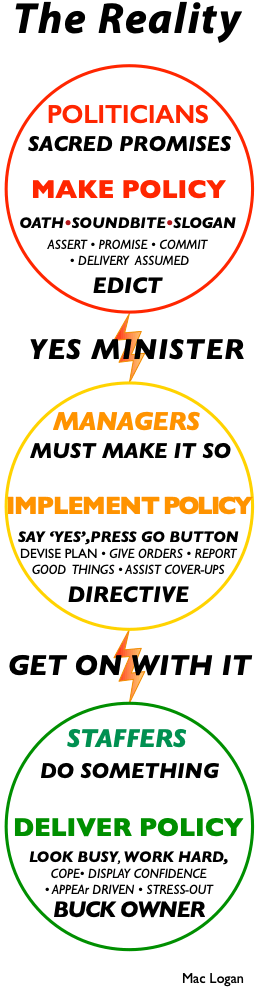
At the outset, UK policymakers create and sell manifesto commitments. Beyond that, things get hazy. Along with the lack of detail, management and control become even foggier and more factional the nearer you get to the coalface. As a result, government projects tend to be delayed, miss targets, and cost far more than expected. Many fail without a trace.
When an election is won, politicians are like werewolves transformed by moonshine. Transfigured by election victory and promotion, shiny, incredibly important people (ministers) hurtle in and out of events, dripping with power, surrounded by a defensive shield of officials. How do the people at the top keep in reliable touch with the getting-things-done real world?
Maybe they don’t. Inevitably, status being what it is, top policymakers don’t attend events run for their policy interpreters or policy implementers, apart from keynote drop-in/rush-off sessions.
Cruel and dishonest work environment
Policy Makers (deities all) depend on Policy Interpreters (mostly relatively senior) and Policy Implementers (less senior) to deliver the desired outcomes. How do people achieve high performance in a capricious and highly pressurised working environment?
The top people don’t get it
For one thing, the top people often “don’t get it” in the real world. What’s more, they can force change on a whim. Thus, well-intended manifestos can be doomed by a lack of expertise and delivery weaknesses. How can we avoid the impact of an autocratic, non-listening, oppressive and childish culture? Might tots have helpful insights to share?
How much opportunity, capability and insight is ignored and wasted? As a result, how much potential and possibility goes down the tubes along with the billions lost to “Fraud and Error”?
A road to hell?
What happens to effectiveness in a world free of accountability? Is the process for getting things done well and on time broken? When delivery begins with a lack of insight and ends in disaster, is it because there are no inevitable consequences for poor performance or failure? Waffle works. Why bother? Mañana.
Problematic culture – flaky bubble
Secure in a bubble of ideology and inner-circle compliance (or else), fine-sounding policies are created and instructions issued. Thereupon, delivery mechanisms groan to half-life. Why, one may ask, does self-evident incompetence and routine disaster fail to shock us? What is the price of the soundbites of almost plausible deniability? Are promises to “learn the lessons” a fair conclusion?
Groupthink
As Irving Janis (1971) suggested when he coined the term ‘Groupthink‘. Using his idea, it seems we are victims of 3 Groupthink pitfalls :
- A dysfunctional decision-making process at the top.
- The corporate unawareness or ignoring of practical, thrifty and humane options for action.
- The irrational avoidance and discouragement of ‘non-supportive’ opinions
Why don’t we demand better? Much, much, much better? If we can’t change and improve (big time), we will wind up where we’re heading. Now there’s a leadership challenge.
Large Scotch, anyone?
© Mac Logan
One thought on “Costly Screw-ups at the ‘Top’ Hurt UK”